Building Volvo Cars Labs
How a digital innovation lab helped Volvo Cars explore new services, business models and customer relationships beyond the vehicle.
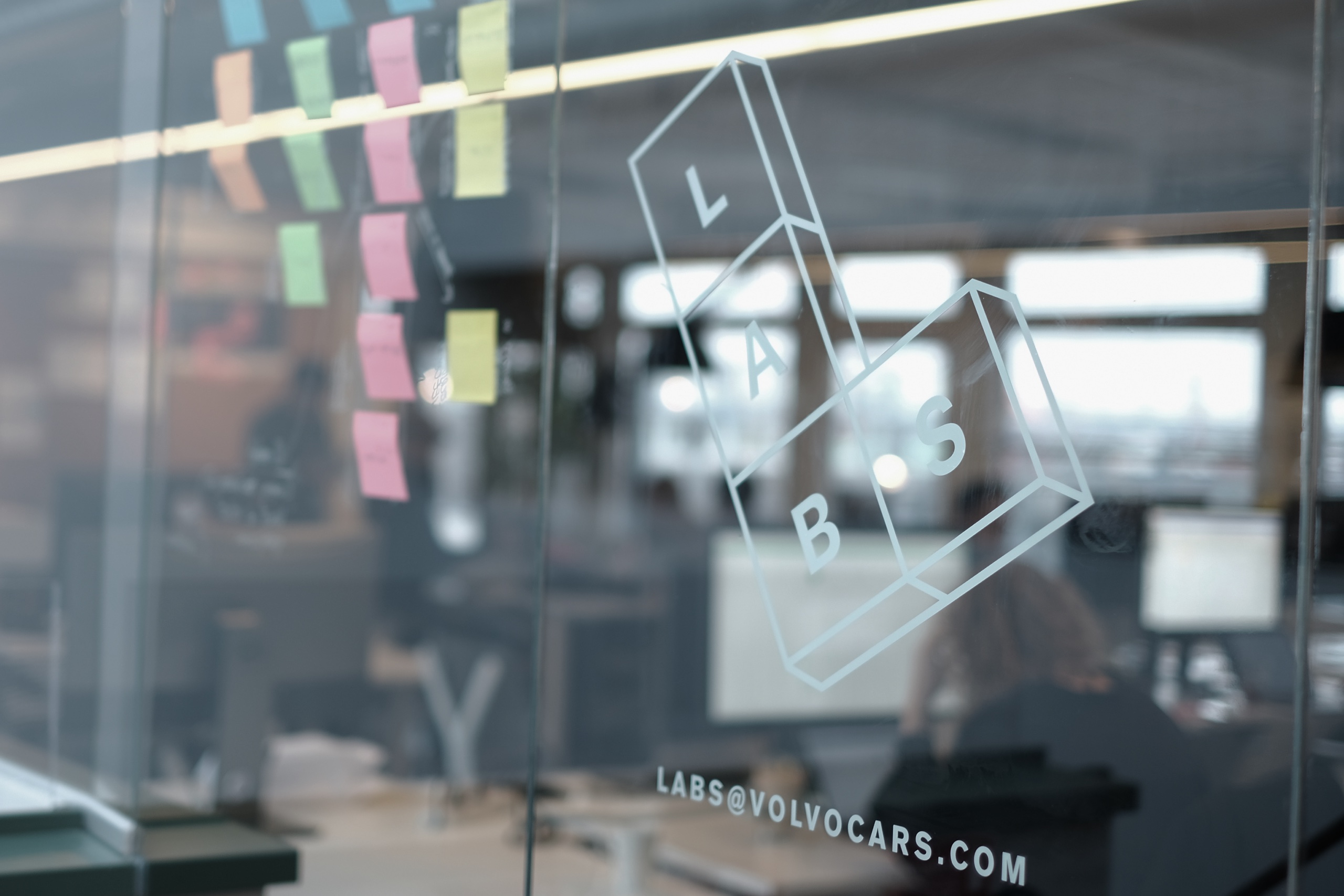
I spent around two and a half years working with Volvo Cars on something that sat a little outside the normal product development structure.
Together with senior leaders, we created a digital innovation lab focused on services and business models around the car.
I joined as a strategic designer and became deeply involved in shaping how the lab should work, which opportunities it should explore and how an idea could move from a question into something we could put in front of real customers.
The timing mattered.
Volvo Cars was going through a much larger digital transformation. Projects were becoming digital products. More capability needed to move in-house. Customer feedback had to arrive during development rather than at the end. Data and metrics would guide decisions, with more room for learning and exploration.
That sounds familiar today. In 2017, inside a large automotive company, it represented a significant change.
Looking beyond the car
The automotive industry was already beginning to move beyond the idea of selling a vehicle and waiting for the customer to return a few years later.
Connectivity was changing that relationship.
The car was becoming part of a larger digital experience. Customers were becoming comfortable with subscriptions, sharing models and services that adapted to them. Volvo’s research pointed towards alternative ownership models, a greater willingness to share vehicle data and growing expectations around personalisation.
This created a different question for us.
What could Volvo do for someone once the car was already sitting in their driveway?
Maybe the value was saving time. Maybe the car could become a secure place for receiving something. Maybe ownership itself could become easier.
The strategy explored ways to reduce the effort involved in everyday tasks such as fuelling, washing the car or receiving packages. It also looked at removing friction around buying, servicing and using a vehicle.
That became fertile ground for the lab.
We needed somewhere to learn
Large companies are very good at building things they already understand.
Innovation creates a different problem.
At the beginning, you usually do not know whether the customer wants the service. You may have no idea what they will pay for it. The technology might work while the business model fails. A concept that looks convincing in a presentation can feel pointless when you put it in someone’s hands.
Building the whole thing before answering those questions is expensive.
A large part of our work was therefore creating a different way to approach them. The lab gave us a place to frame an opportunity, make something small and learn from what happened.
The wider Volvo strategy was moving in the same direction. It called for learning and exploration, co-creation with partners and faster responses to signals from customers. Our job was to turn that intent into a way of working.
The lab was not a place to protect ideas. It was a place to expose their weakest assumptions early.
Designing the lab itself
This was probably the most interesting part of my role.
We were designing services, but we were also designing the machinery that allowed those services to be explored.
How should an idea enter the lab? What evidence did we need before spending more money on it? How small could the first experiment be? Who needed to participate? When should we stop? When did an experiment become something Volvo should own and scale?
Those questions became part of the framework and working model we developed.
My background in service design was useful because I could move between the customer experience and the business around it. A service has to make sense from both directions.
We worked with prototypes and pilots rather than long specification phases. Teams could explore the customer journey, test the technology and begin understanding the commercial side while the idea was still inexpensive to change.
Some experiments needed a screen. Others needed a concierge service, a partner or a car in the real world. The prototype depended on the question.
This changed the role of design. The goal was not always to make the concept look complete. It was to create the smallest convincing experience that would help us learn what to do next.
The car became part of the service
One idea I found particularly interesting was that the vehicle could take on a new role.
It already had an identity, connectivity, a location and a secure physical space. That opened up services that would have sounded unusual only a few years earlier.
The work included experiments around fuel and car washing, peer-to-peer sharing, pick-up and drop-off services and in-car logistics. Concepts were built, prototyped and piloted across different markets rather than treated as one large launch programme.
One example was in-car delivery.
The basic idea was simple. Ordering something online was easy. Receiving it could still be annoying.
If the car could become a secure delivery location, the customer would no longer need to wait at home for a package. Volvo explored this together with Amazon, connecting the service to Volvo On Call and secure access to the vehicle.
There were many ideas like this. Some were useful because they had the potential to become real services. Others were useful because they taught us something about what customers expected from Volvo.
That distinction matters in innovation work.
An experiment can fail as a product and still succeed as an experiment.
Business models entered the design conversation
Working beyond the vehicle meant design could not stop at the customer journey.
We had to ask how the service would work as a business. Who provides it? Who pays? What happens when another company becomes part of the customer experience? Does Volvo operate the service or connect the customer to someone else? What needs to be true for the idea to work across several markets?
These questions changed how I worked as a designer.
I spent more time with strategy, partnerships and business models. Sometimes a prototype tested the service experience. At other times it exposed a weak assumption in the business. We learned to treat those things as one problem.
A smooth customer journey means very little if the partnerships, economics or operational responsibilities behind it cannot hold. The lab made those hidden parts of the service visible while there was still time to change them.
Working close to leadership
The lab had support at C-level, and that made a difference.
A small experiment can reveal problems that sit far outside the team running it. Data ownership, technology platforms, legal questions or the way Volvo works with partners could all become part of what we discovered.
The wider transformation programme was dealing with many of the same issues. Volvo was moving towards product teams with broader ownership and end-to-end accountability while building more internal digital capability.
My role often sat between those levels.
I could be working on the details of an experiment and then step back to discuss what we were learning about Volvo’s future services, organisation or capabilities. That is where strategic design became useful.
It connected the immediate question—does this service make sense?—to the larger one: what would Volvo need to become capable of delivering it?
A cheaper way to find out
The work was rarely about predicting the future correctly. It was about creating a cheaper, faster and more grounded way to find out.
Volvo Cars Labs gave uncertain ideas somewhere to become tangible. It allowed customer value, technology, business models and organisational capability to be explored together rather than passed between separate phases.
Some experiments pointed towards services worth developing. Others helped us stop, redirect or understand the problem differently. Both outcomes created value because they replaced assumption with evidence.
That is what stayed with me from the work. Innovation does not need a protected room full of perfect ideas. It needs a deliberate system for asking better questions, making the future concrete and learning before certainty becomes expensive.