The shift from UX to AX has already begun
AI changes the design question from how someone moves through an interface to why they are here—and what the system should do with that understanding.
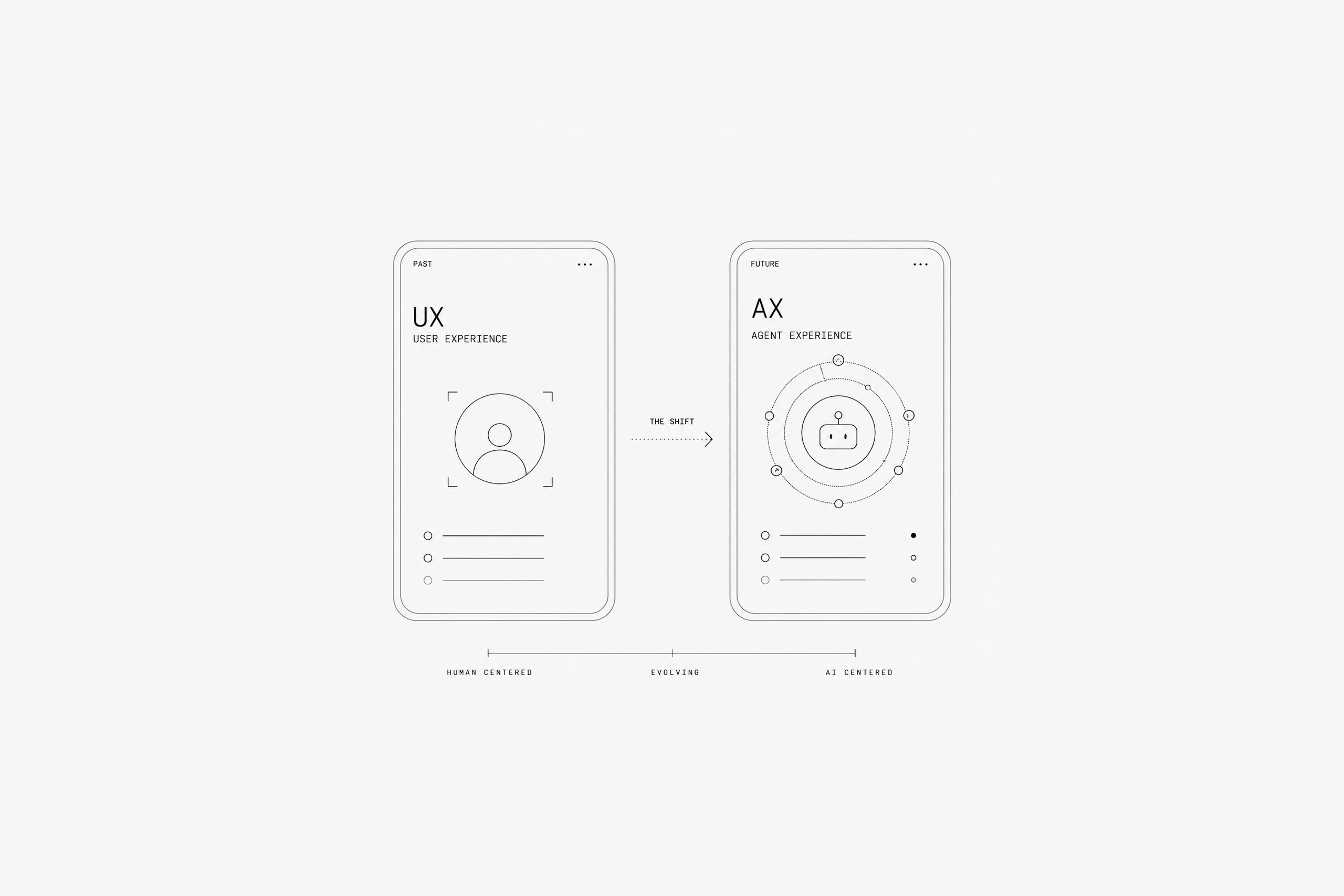
For most of the digital era, we have built products around the same basic agreement: one designed experience, delivered to millions of people. Everyone receives the same navigation, the same sequence and the same interface. We became very good at refining that model.
It was progress, but it was also a constraint.
For the first time, we can build digital services that respond to an individual person rather than a segment or an average. AI makes it possible for an experience to change according to context, history, ability and intention—not only between releases, but while someone is using it.
That does not make UX obsolete. It changes the material we are designing. The shift is from User Experience as a predefined path to AI Experience, or AX: a system that interprets intention and constructs an appropriate response.
From how to why
Product teams have spent decades improving how someone moves through a screen. We have optimised clicks, hierarchy, navigation and linear journeys. This work still matters, but a usable interface is no longer a meaningful advantage on its own. It is the minimum.
As interfaces become easier to generate and natural language becomes another way to operate software, the decisive question moves elsewhere. Why is this person here? What are they actually trying to achieve? What would a useful outcome look like in this moment?
The interface tells us what someone can do. Intention tells us why any of it matters.
The limitation of one-to-many
I understood the scale of this shift when I looked back at the products and services we have built over the years. Nearly all of them shared the same limitation: they were one-to-many. Every SaaS product and digital service delivered roughly the same experience to everyone because doing otherwise was too expensive and too complex.
Research helped us make that shared experience more informed. We interviewed people, found patterns, created personas and translated thousands of individual needs into one generalised solution. That is difficult and valuable design work. But the output remained static.
AI loosens that constraint. A service can now respond differently to different people, not by choosing between a few predetermined variants, but by assembling language, actions and interfaces around a particular goal. The experience becomes something the system produces with the user, not only something a team completed before the user arrived.
UX asks what our users need and builds an answer. AX asks what this person needs now and creates the response in the moment.
But isn’t that already UX?
Good UX has always been concerned with human goals rather than screens. Designers investigate needs, map motivations and question the brief. In that sense, AX does not replace the foundation of UX. It makes that foundation operational in a new way.
The difference is what happens after we understand the need. In a traditional product, insight is compressed into a fixed flow. In an AX system, interpretation continues during use. The system observes context, forms a view of intention, acts, and adjusts when it learns more.
That is not simply a smarter interface. It is a different architecture—one with probabilistic behaviour, changing outputs and consequences that cannot all be designed in advance. The designer’s responsibility therefore expands from composing paths to shaping how the system reasons, communicates uncertainty and recovers when it is wrong.
Designing for intention
Intention is not a binary switch. It stretches from the explicit goal someone can state to the implicit, emotional reason underneath it.
Imagine searching for “a good restaurant nearby” on a Friday evening. The explicit intention is to find somewhere to eat. The implicit intention might be to celebrate, impress someone, escape routine or find a quiet place after a difficult week. A conventional product returns a ranked list. An intention-aware service could recognise the kind of evening the person wants and shape the recommendation around it.
That possibility is powerful, but it also introduces risk. Inference can be wrong. Personalisation can become manipulation. Helpful anticipation can feel like surveillance. AX must therefore be designed with visible boundaries: when the system should ask rather than assume, how it explains a suggestion, how much control remains with the person and how easily an incorrect interpretation can be changed.
Understanding intention is not permission to remove agency.
The same car, a different experience
The idea becomes tangible in a car. Today, two drivers of the same model largely meet the same instrument panel, menu structure and infotainment system. Their contexts may be completely different, but the interface begins from the same state.
Now imagine a car that understands someone is driving home late on a Friday. It reduces visual noise, adjusts the environment and proposes a calm route—not because the driver configured a mode, but because the system recognised the likely intention: get home safely and decompress. Another driver, in the same model, might receive a completely different response.
This is AX in practice. Not a better screen. A better understanding.
The challenge is to make that understanding trustworthy. A car should not silently make consequential decisions based on a fragile guess. The experience must communicate confidence, preserve control and know when doing nothing is the best response.
1. The interface recedes
Today we are designing better conversations with AI. But conversation is still an interface. When a system can understand context with enough confidence, many interactions may no longer require a command at all.
This is often described as Zero UI, but disappearance should not become a goal in itself. An interface is valuable when people need orientation, consent or control. The future designer decides which interactions can recede into the environment and which must remain deliberately visible.
2. Designers govern possibility
Generative interfaces will allow systems to assemble layouts, language and actions dynamically. Designers will no longer be able to specify every state by hand. Their work moves up a level.
The task becomes defining the space within which the system may act: the brand principles it should express, the behaviours it must avoid, the evidence required before it acts, and the fallback when confidence is low. Designers become governors of a living system rather than authors of a finite collection of screens.
3. AI is not a partner
We often describe AI as a partner because the metaphor feels reassuring. But AI has no consciousness and no ability to care. Designing it as an artificial friend can obscure what the system is actually doing and who remains responsible.
A more useful ambition is to design a cognitive exoskeleton: an intention-aware system that expands what a person can understand, create or accomplish. The goal is not to make AI more human. It is to make people more capable without weakening their judgement or autonomy.
4. Intention is not the moat
As models become better at interpreting human intention, that capability will become widely available. Knowing the digital “why” will not remain a competitive advantage on its own.
The organisations that create durable value will connect that understanding to what I think of as action capital: real infrastructure, operational capability, supply chains, domain knowledge and deeply earned trust. A system can understand what someone wants perfectly and still fail if the organisation cannot deliver.
The digital why is nothing without the physical how.
Who leads this shift?
AX cannot be developed through a conventional feature factory. It needs people who can bridge raw AI capability and human outcomes—leaders who understand that unreliable AI is a failed product, not merely a technical limitation.
They will need to work across design, engineering, data, ethics, operations and business strategy. They will decide not only what a system can do, but what it should do and who carries the cost when it gets that judgement wrong.
The strongest leaders in this space will be those who can orchestrate the relationship between human intention and machine action while protecting trust. That relationship may become one of an organisation’s most valuable assets.
Intention is everything
We are entering an era of collaborative intelligence, and I believe it is one of the most consequential moments to work between technology and human behaviour.
The questions are already here. What happens to your product when its interface is no longer the differentiator? What changes when the service can adapt to one person in one moment? Which decisions should the system make, which should remain human, and how will people know the difference?
There are no simple answers. That is precisely why designers and organisations need to begin exploring them now. The shift from UX to AX is not waiting for a new job title. It has already begun.