What I learned from talking about AI
A year of conversations with CTOs, marketers, product teams and public-sector leaders changed the question from what AI can do to what organisations should do next.
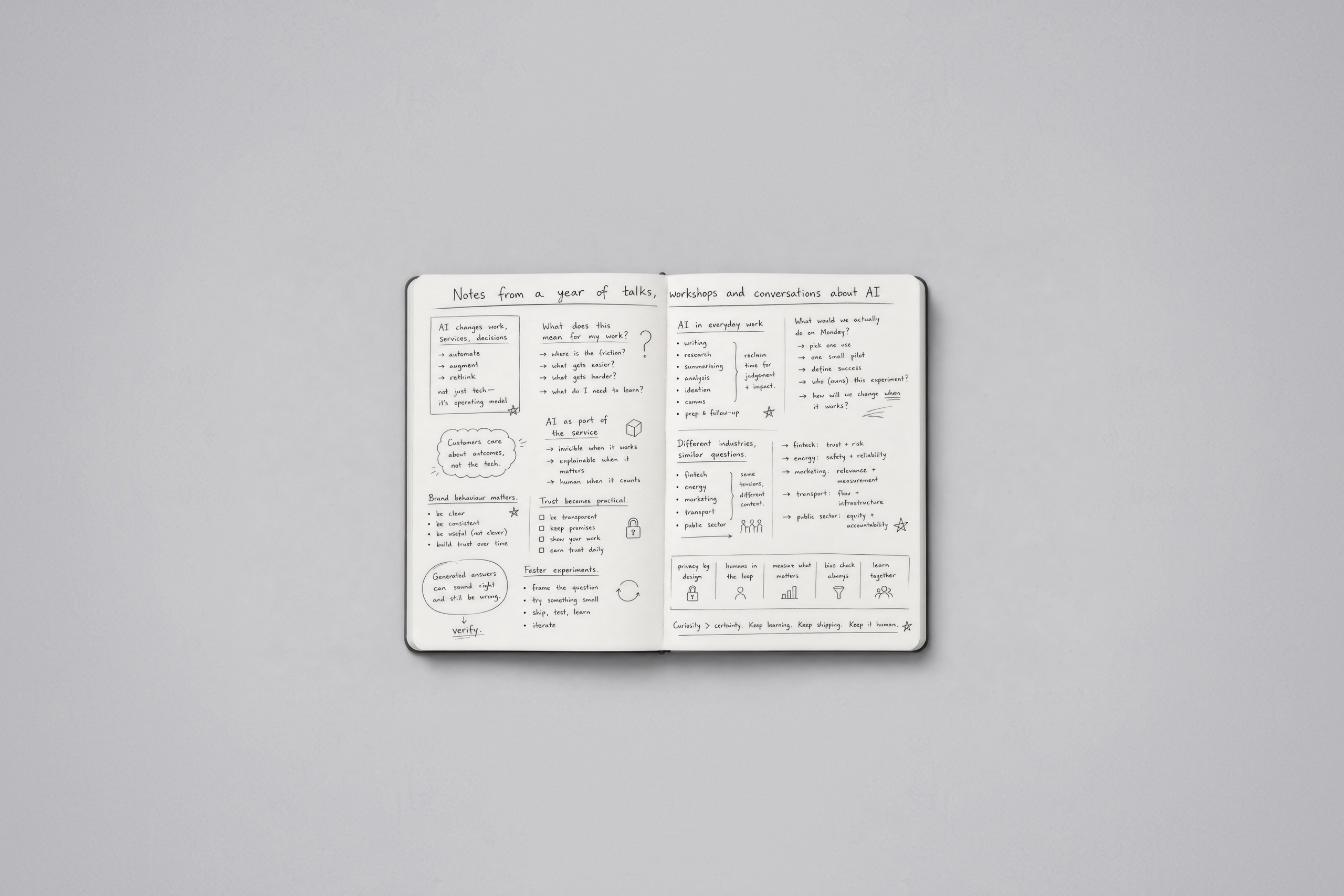
Over the past year, I have spent a lot of time talking about AI.
Sometimes it was to a room full of CTOs. Sometimes to marketing teams, innovation groups, product people or public-sector leaders. The level of knowledge in the room could be completely different, but the questions were often surprisingly similar.
What does this actually mean for my work?
That became the starting point for most of my talks.
I have never been especially interested in AI as a technology subject on its own. My background is in design, services and product development, so I tend to approach it through what changes for people.
What happens to a service when it can understand what someone is asking? What happens to a team when everyone can create a prototype, analyse information or explore an idea in a few minutes? And what happens to an organisation when this begins happening everywhere at the same time?
Those questions became more interesting to me than another demonstration of what a model could generate.
The conversation moved quickly
In the beginning, people wanted to understand the basics. What is generative AI? What can ChatGPT do? Which tools should we try?
I gave talks for organisations including GREAT and STENA where a large part of the job was making AI understandable and showing where it could fit into normal work: internal processes, communication, research and customer interactions. Things people could recognise from their own day.
That discussion moved on quickly.
Once someone has used AI to write an email or summarise a document, the interesting question is what they do next. A product person starts wondering whether AI could become part of the product itself. A manager starts looking at an entire workflow. A marketer begins thinking about communication that changes with the customer, the context or what is happening right now.
The tool disappears from the conversation. What remains is the service.
AI changes how I think about services
This has probably been the strongest thread through my talks.
Most digital services have been designed around fixed paths. Someone decides what the user can do, which button comes next and what happens when they press it. AI makes that model much less rigid.
A service can interpret what someone writes. It can work with incomplete or messy information. It can generate something specific to the situation. Sometimes the next step does not need to be designed as a screen at all.
That opens a very different design problem.
If a system can respond in many ways, we have to think about what it knows, where the information comes from and how much the user should trust the answer. We also have to decide where the system should stop, when it should explain itself and when a person needs to take over.
Those are design questions. They are also product questions.
I spoke about this from different angles depending on the audience. With Waya, it was connected to fintech, user flows and prediction. With Metry, the subject was energy data, reporting and finding patterns. With Volvo Trucks, it was connected to marketing and how teams plan and measure their work.
Different businesses, but the same shift. You start with AI as a feature and soon find yourself redesigning how the service works.
A brand now needs behaviour
One of my talks at the School of Business, Economics and Law in Gothenburg was about the future of brands in the age of AI. That subject stayed with me.
For years, we have designed brands as systems: typography, imagery, tone of voice and rules for how things should look and sound. AI introduces another layer because the brand can now generate things.
It can answer a customer. Create an image. Change a message. Help someone choose a product.
That makes brand behaviour much more important. It also makes trust very practical. A generated answer can sound completely correct and still be wrong. A service can use the right visual language and still behave in a way that feels strange for the company behind it.
I think this will become a larger part of brand design. We will spend more time defining how a brand should reason, respond and behave inside a system, because static guidelines cannot cover every situation anymore.
Speed changes the work
Another theme began appearing when I spoke about innovation: AI makes it cheap to try things.
That sounds obvious, but it changes a lot.
At the West Sweden Chamber of Commerce, I talked about using AI and experiments to explore new markets. At Autoliv, the discussion was closer to innovation and product development. How quickly can we move from an idea to something we can actually test?
For a long time, we spent a great deal of energy describing future ideas through presentations, journeys, concept decks and business cases. Now I can often build enough of an idea to learn something from it.
It may be rough. That is fine.
Put it in front of someone. See what breaks. Notice what they understand without explanation.
This changes the discussion inside a company because people are reacting to something they can use instead of debating a slide. It also means more ideas can die early. I like that. An idea that fails cheaply and clearly has still done useful work.
Then you meet the organisation
The technology is usually the easy part.
After companies begin experimenting, another set of questions appears. Someone has made something useful. Who owns it now? Can it use company data? Should it become part of an existing product? Who is allowed to make that decision?
This became a larger part of the work I did with Volvo Buses and Volvo Group. Those conversations moved into AI maturity, leadership and how companies make this part of everyday work.
You can give thousands of people access to the same AI tool tomorrow. The organisation does not change tomorrow.
Teams still have budgets, systems, responsibilities and established ways of making decisions. AI starts moving across those boundaries very quickly. That creates a strange situation: an individual can suddenly work in a completely different way while the company around them still operates as before.
I think many organisations are entering that phase now. The next challenge is not access to AI. It is creating the conditions for useful experiments to become responsible, shared capability.
The Monday question
Talking about AI has changed how I work with it. Giving these talks has forced me to explain my own thinking, and that has been useful.
You notice very quickly when an idea sounds good on a slide but falls apart when someone in the audience asks a simple question: “Okay, but what would we actually do on Monday?”
That is usually the right question.
It has pushed me towards smaller experiments, real use cases and things people can try themselves. I still follow the models and tools closely. Of course I do. They change every week. But when I walk into a company now, I usually look somewhere else first.
I want to understand how people work. Where does something slow down? Where is knowledge lost? Which decisions depend on information that is difficult to find? What do people repeatedly create from scratch?
That tells me much more about where AI might matter.
Start with the work
The past year has taught me that AI conversations rarely stay technical for long. They become conversations about services, trust, brand behaviour, decision-making and the shape of the organisation itself.
The strongest starting point is not a model or a tool. It is a piece of real work that people recognise, a question worth exploring and something small enough to test.
That is where AI becomes useful. It is also where design has a meaningful role to play.