Designing a service for one
A fitness concept became a way to explore how specialized AI agents could coordinate around one person, one changing context and one goal.
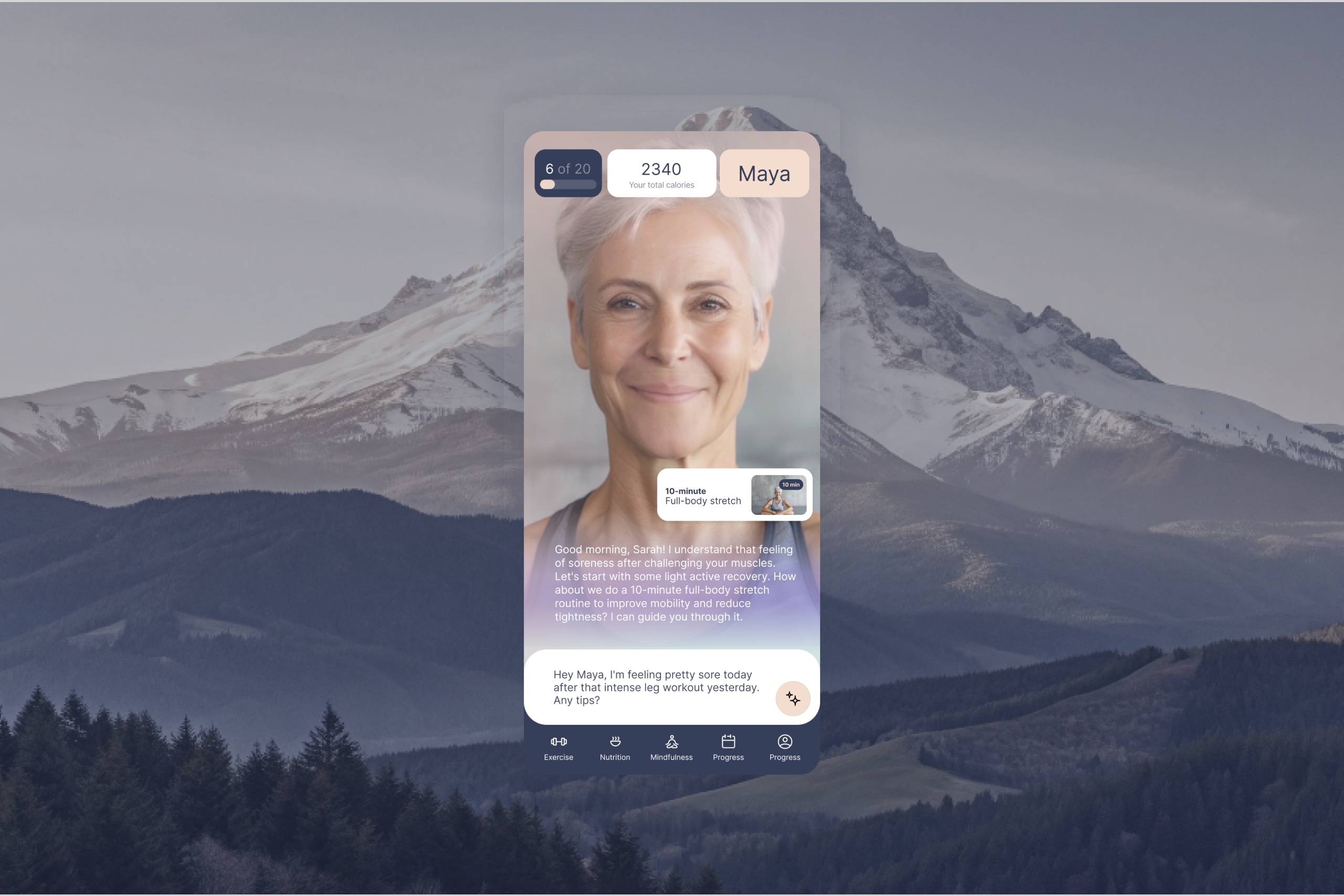
Most digital personalisation is not truly personal. It remembers a name, rearranges a feed or recommends something that similar people chose before. The surface changes, but the service underneath remains largely the same.
Agentic AI opens a more demanding possibility: a service that can interpret a goal, coordinate specialist capabilities and adapt its actions as a person’s situation changes. Not a generic experience with personalised decoration, but an experience assembled for one person in one moment.
I explored that idea through fitness. The concept began as a simple question: what would happen if an AI service understood enough about your body, routines and ambitions to adjust the entire experience around you?
Personalisation is a moving target
Fitness makes the limits of static recommendations easy to see. No two people share exactly the same physiology, history, schedule or motivation. Even for one person, the right plan on Monday may be wrong on Thursday. Sleep, stress, soreness, injury, available time and energy all move from day to day.
A conventional fitness product asks someone to choose a goal and then places them into a programme. It can offer alternatives, but the structure is still predetermined. An adaptive service would treat the plan as a living hypothesis. Every workout becomes new information. Every skipped session, difficult night or change in routine alters what should happen next.
The aim is not to optimise every minute of someone’s life. It is to make the service sensitive to reality instead of expecting reality to conform to the programme.
A day with an adaptive coach
Imagine waking up after poor sleep. The service already knows that the previous day’s training load was high, but it does not silently decide what is best. It presents what it has understood, asks how you feel and proposes a lower-intensity session.
During the workout, motion analysis helps with form while the training plan adjusts weight, repetitions and rest. If soreness appears, the service can replace an exercise and explain why. Afterwards, nutrition and recovery guidance reflects what actually happened rather than what the original schedule expected.
Later, the plan for tomorrow changes. Not as a dramatic intervention, but as a small correction made across the whole service.
This is where agentic systems become interesting. The value is not that an AI can generate a workout or a meal. Many tools can already produce plausible suggestions. The value comes from continuity: the service remembers the goal, understands the current state and coordinates the next useful action.
The product is not any single agent. It is the quality of the coordination between them.
One experience, many specialists
The concept used several specialised agents working as one service. A training agent shaped exercises and progression. A motion agent interpreted movement. A recovery agent considered fatigue and rest. A nutrition agent connected food guidance to training load. A planning agent adjusted the longer journey, while a support agent considered tone, encouragement and when silence would be more useful than another notification.
From the user’s perspective, these should not feel like six different products. They should feel like one coherent relationship. The language, memory and priorities must be consistent even when the expertise comes from different models or systems.
That makes orchestration a design problem, not only a technical one. What happens when one agent recommends rest and another sees an opportunity to increase intensity? Which signal has authority? When should the system ask for more information? When does a safety rule override the personal goal?
A central orchestrator can combine signals and resolve conflicts, but its decisions still need principles. Without them, a network of capable agents can produce a fragmented or even unsafe experience.
The architecture is part of the experience
An adaptive service needs a shared understanding of the person’s goal, current state and history. It also needs clear boundaries around what each agent can access and do. Shared memory may create continuity, but unlimited memory creates risk. Real-time data may improve relevance, but collecting everything simply because it is available is not a product strategy.
The system has to work across different kinds of input: conversation, movement, wearable data, self-reported mood and environmental context. None of these signals is complete on its own. A heart-rate pattern does not explain how someone feels. A confident sentence does not mean the body is ready. Good orchestration depends on combining evidence while remaining honest about uncertainty.
The experience must therefore reveal enough of its reasoning to be questioned. A recommendation should distinguish between measured data, user input and inference. People should be able to correct the model, limit the data it uses and understand when advice falls outside the system’s competence.
This is particularly important in fitness, where confident language can easily be mistaken for medical authority. An adaptive coach should know when to stop, reduce scope or direct someone towards qualified human support.
Beyond fitness: vertical agentic services
Fitness is a useful test case because the goal is personal, conditions change frequently and several domains must work together. The same structure can apply wherever deep expertise and continuous adaptation create value.
In education, specialised agents could coordinate content, pace, feedback and accessibility around one learner. In travel, they could revise an itinerary as weather, transport and personal priorities change. In finance, they could connect everyday decisions to longer-term goals while keeping regulated advice and human accountability visible. In healthcare, they might support monitoring and preparation, but only within carefully defined clinical boundaries.
I call these Vertical Agentic Services: systems built deeply into one domain rather than general assistants stretched across every problem. Their advantage is not simply that they know more facts. They understand the structure of the service—the roles, constraints, handovers and consequences that make action useful in that particular context.
A general model can suggest. A vertical service has to deliver responsibly.
Personalisation needs boundaries
The closer a service gets to an individual, the more carefully it must handle trust. Hyper-personalisation can support someone, but it can also pressure, manipulate or narrow their choices. A system that knows when motivation is low could offer encouragement; it could also exploit vulnerability to increase engagement. The technical capability is the same. The intent and governance are not.
Designing for one therefore cannot mean optimising a person without their participation. The individual must remain able to set the goal, see what the system believes, change direction and withdraw permission. Personalisation should increase agency rather than quietly transfer it to the system.
The best adaptive experience may sometimes choose not to act. It may ask a question, show uncertainty, offer alternatives or hand the decision back. Restraint is part of intelligence.
A service that evolves with you
The fitness concept began as an exploration of what agentic AI might make possible. It became a broader way to think about service design.
We are moving from products that wait for input towards systems that can interpret, coordinate and act. But autonomy alone does not create value. The service must remain coherent across agents, grounded in real context and accountable to the person whose life it is trying to support.
A truly individualised experience is not one that predicts everything about you. It is one that can learn with you, explain itself and adapt without taking away your ability to choose.
That is the promise of a service designed for one—and the standard agentic AI will need to meet.